By Kyle, Draft Beer Technician | Renny's Draft Solutions | The Knowledge Tap
The short answer: Keg yield is the percentage of the beer in a keg that you actually sell. A half-barrel keg holds 1,984 ounces — about 132 pours at 15 ounces of beer each. A well-run draft system sells 90% or more of that (roughly 119 pours). Most systems sell closer to 75% (about 99 pours). On a $175 keg poured at $6.50, that gap is worth approximately $131.85 in profit, every keg.
I've spent 15+ years building and servicing draft systems — breweries, taphouses, restaurants, and casino floors across the country. If I could get every bar owner in Central Oregon to track one number, it wouldn't be beer cost or pour cost. It would be keg yield.
Because keg yield is where the money hides. You paid for every ounce in that keg. The only question is how many of those ounces made it into a glass and onto a ticket — and how many went down the drain as foam, top-offs, and dumped first pours.
Here's how to measure it, what a good number looks like, and where the missing beer actually goes.
What is keg yield?
Keg yield is the beer you sold divided by the beer you bought:
Keg yield % = (pours sold × ounces per pour) ÷ ounces in the keg × 100
That's it. No equipment required — just your keg size and your POS.
One detail trips people up: a 16-ounce pint glass doesn't hold 16 ounces of beer. A proper pour has about an inch of foam on top, which leaves roughly 14–15 ounces of liquid. That head isn't waste — it's how beer is supposed to be served, and it's why we figure yield on a 15-ounce pour. If you do the math on 16 ounces, your yield will look worse than it really is.
How many pours are in a keg?
Here's the theoretical maximum — 100% yield, zero loss — for the three keg sizes you'll see in Central Oregon:
Nobody hits 100%. A small amount of loss is built into draft — the beer left in the line after cleaning, the last few ounces when a keg kicks. But there's a big difference between "a small amount" and one keg in four.
How to measure your keg yield (using your POS)
You don't need flow meters to get a real number. You need two things you already have: the keg size and your POS product-mix report.
- Pick one beer. Your best-selling house beer is the easiest.
- Write down when the keg goes on and when it kicks. Date and time, taped to the cooler door. That's your measurement window.
- Pull the product-mix (PMIX) report for that beer over that window. Count every pour — pints, pitchers, flights, and comps. If your staff pours shift beers or comps without ringing them in, ring them in at $0 for the test. Otherwise you're measuring your POS, not your system.
- Convert to ounces and divide. Pours × ounces per pour ÷ ounces in the keg.
Example: A half barrel of IPA sells 108 pints. 108 × 15 oz = 1,620 oz. 1,620 ÷ 1,984 = 81.7% yield. At 90%, that same keg sells about 119 pints. That's 11 pints — about $71.50 at $6.50 — gone on one keg of one beer.
Run it on three or four kegs before you trust it. One keg can lie. Four kegs show you a pattern.
What a good keg yield looks like
- Under 75% — something is broken. Usually more than one thing.
- 75–80% — typical. Most draft systems lose 20–25% of every keg, and it feels normal because it's been that way for years.
- 80–89% — better than most, still leaving money in the drain.
- 90%+ — a system that's built right, balanced right, and cleaned on schedule.
Here's what the gap between 75% and 90% is worth on a half barrel ($175 keg, 15-ounce pour, $6.50 a pint):
Now multiply it out:
Math: $131.85 × kegs per week × 52 weeks × years. Want to plug in your own keg cost and pint price? Run it through the Draft Beer Profit Calculator.
One note if you pour sixtels: don't divide $131.85 by three. Work it from pours — a sixtel holds about 44 fifteen-ounce pours, so each point of yield is worth roughly 0.44 pours times your pint price. The percentage matters just as much; the dollars per keg are smaller.

Where the missing beer goes
When I walk a system, I split the loss into two buckets. It matters, because they have different owners.
System losses — the draft system's job
These come from the Big 3. Per the Brewers Association Draught Beer Quality Manual, every pour problem traces back to temperature, applied pressure, or line cleanliness.
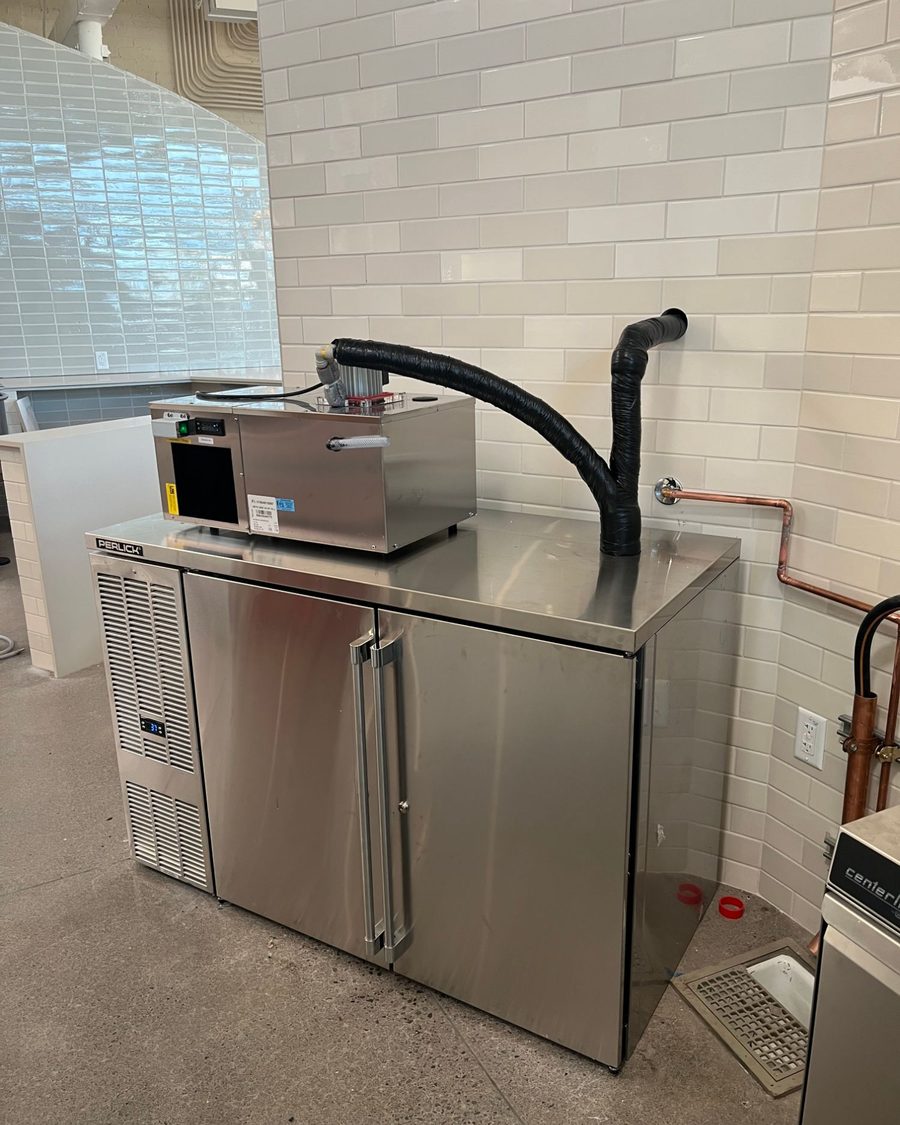
1. Temperature. Beer needs to sit at 36–38°F and stay there all the way to the faucet. A few degrees of warming in an uninsulated tower or a cooler that runs warm during the Friday rush, and CO2 breaks out of the beer. That's foam — and foam is beer you paid for. On remote systems, this is why we run glycol-cooled trunk lines instead of air-cooled ones: a glycol bath held at 29–32°F keeps every line cold all the way up to the faucet.
2. Applied pressure. Every beer has a carbonation level, and the gas pressure has to match it at your temperature. Too much and the beer over-carbonates and pours wild. Too little and it goes flat in the keg. Pressure gets set once, based on the beer — it's not a knob for fixing a slow pour. And here in Bend, at roughly 3,623 feet, the same beer needs about 2 psi more on the gauge than it would at sea level — gauges read against the outside air, and there's less of it up here (the BA rule of thumb is +1 psi per 2,000 feet). Use the sea-level chart and the beer slowly goes flat. Then someone cranks the gas to fix it, overshoots, and you're pouring foam. More on dialing in CO2 pressure here.
3. Cleanliness. Yeast, bacteria, and beer stone build up inside the line. Rough spots in the line knock CO2 out of solution, and the beer foams. The Brewers Association standard is a full caustic cleaning every 14 days, maximum — recirculated through the lines, with faucets taken apart and couplers scrubbed. Monthly feels like plenty. By week three, it isn't. Here's why the 14-day interval matters.
Then there's keg changes on long-draw systems. A 100-foot run of 3/8-inch line holds about 73 ounces of beer — nearly five pints. When a keg kicks on a remote system with no foam-on-beer detector (FOB), gas and foam push into that line, and the next several pours go down the drain. That's why every remote system we install gets FOBs from Pacific Beer Equipment. On a direct-draw cooler, the keg sits right under the tap and you don't need one.
Operational losses — the bar's job
These don't come from the system. They come from the bar: over-pours, free top-offs on a foamy pour, spills, shift beers and comps that never hit the POS, and kegs pulled before they're actually empty.
I'm not going to pretend a cleaning service fixes those. What we can do is separate them from the system losses, so you know which problem you actually have. Plenty of owners blame their bartenders for a yield problem that's really a 42°F walk-in. And plenty blame the system for a pour problem that's really training.
What I check first on a walkthrough
When I walk into a bar to look at yield, three checks tell me most of the story inside ten minutes:
- Thermometer in a fresh pour. If it reads above 38°F, temperature is the first fix.
- A stopwatch on a pint. A balanced system pours about 2 ounces per second — roughly 8 seconds for a pint. Much faster and it splashes into foam. Much slower and your bartenders fight it on every busy night.
- The date of the last cleaning. If nobody knows, that's the answer.
After that comes the gear: chrome-plated brass in the beer path, old vinyl line, straight CO2 on a long run that should be on blended gas. Each one is a slow leak in your yield.
Why this matters in Central Oregon
This is a beer town. Your regulars have toured the breweries, and they know what a fresh IPA is supposed to taste like. A foamy, half-flat pint here doesn't just cost you the beer — it costs you the second round.
That's the room we work in. Renny's is brewer-owned and Bend-based. Brandt came up brewing at 10 Barrel, GoodLife, and Boneyard. I'm the draft technician — 15+ years designing, installing, and tuning draft systems, with keg yield as my specialty. We take care of 100+ clients across Central Oregon, including Sunriver Brewing, Van Henion Brewing, Worthy Brewing, Bend Brewing Company, Initiative Brewing, 10 Barrel Brewing, and Sunriver Resort, and we hold a 5.0 Google rating from 75+ five-star reviews. Hear it from our clients.
The guarantee
On systems we install and maintain on our bi-weekly (14-day) line cleaning plan, we guarantee 90%+ keg yield. If at any time the system isn't hitting 90%, we keep working until it is. When we control both the build and the cleaning schedule, we'll put our name on the number.
On a system we didn't install, or one on a longer cleaning interval, we won't guarantee a number we don't fully control. We'll do everything we can to maximize your yield, and we'll tell you straight what's holding it back.
Find out your number — free
You can run the POS test above yourself this week. Or let us do it with you.
Book a free Draft System Profit Assessment. It's a 30-minute walkthrough. We check your system, find where your yield is going, and hand you a custom ROI report showing what you're leaving on the table. No obligation.
Keg yield FAQ
What is a good keg yield?
90% or higher. Most draft systems run around 75–80% without anyone noticing. Under 75% means something in the system is broken.
How many pints are in a half-barrel keg?
A half barrel holds 1,984 ounces: 124 sixteen-ounce pours of liquid, or about 132 pints poured properly with a one-inch head (roughly 15 ounces of beer per glass).
Does foam count as lost yield?
The head on a properly poured pint doesn't — that's how beer is meant to be served. Foam that gets dumped, overflows the glass, or forces a top-off does.
How often should beer lines be cleaned to protect yield?
Every 14 days, maximum, per the Brewers Association standard. Dirty lines cause foam, and foam is lost beer.
Does elevation affect draft beer in Bend, Oregon?
Yes. At about 3,623 feet, Bend systems need roughly 2 psi more applied pressure than the same beer at sea level. Skip the adjustment and you get flat beer — or foam once someone over-corrects.
– Kyle, Renny's Draft Solutions
Renny's Draft Solutions serves Bend, Redmond, Sisters, Sunriver, and the greater Central Oregon region. Custom draft system design and installation, bi-weekly and monthly line cleaning plans, system upgrades and optimization.